A professional thank-you should help its recipient understand what was useful. It does not need an exaggerated compliment or a paragraph about how busy they must be. A clear subject, one observed contribution and an accurate next step usually carry the message.
After visiting a company
Subject: Thank you for Tuesday’s visit
Hello [name],
Thank you for showing us how your team handles [process]. Seeing the handover between [two stages] clarified a question we had discussed before the visit. I also appreciated the time set aside for our questions.
As agreed, I will send [the promised item] by [date]. Please let me know if there is a preferred format.
Best regards,
[name]
Do not include confidential operational details in a widely copied email. If the visit was exploratory, do not imply that a partnership was agreed. The most professional sentence may be the one you leave out.
After a training session
“Thank you for today’s session on [topic]. Practicing [specific task] made the explanation easier to apply than a slide alone. I plan to try [small action] in our next [work situation]. Could you send the worksheet you mentioned, or point me to the right location?” This communicates appreciation and one bounded request. Do not claim a skill has been mastered after one session.
After a project update
An update is often a practical exchange, so a short response is appropriate:
- “Thank you for the update. The revised delivery date lets us adjust the launch checklist.”
- “Thanks for clarifying what is still outstanding. I will review the two open questions before Thursday.”
- “Received, thank you. I have noted the change and will use the new version.”
- “Thank you for flagging the delay early. Please confirm whether the review meeting should also move.”
Each reply does different work: explain a consequence, commit to an action, acknowledge receipt, or ask for a decision. Choose the job your email actually needs instead of adding several polite synonyms.
When appreciation and disagreement coexist
“Thank you for setting out the options. I agree that the deadline is the main constraint. I have a different view on the proposed scope, which I have outlined below.” You can recognize clarity without agreeing to a plan. A thank-you is not a substitute for saying no.
A cleaner opening than a stock greeting
“I enjoyed our conversation about the handover” or “I am following up on the worksheet from Tuesday” connects the email to a real exchange. “I hope you are doing well” is not wrong, but it is optional. If you do not know the recipient personally, do not invent familiarity to make the opening warmer.
A pre-send edit
Check names, dates and attachments. Remove any promise you cannot keep. Read the subject with the body closed: can the recipient tell what the email concerns? Then check whether the final line requires a response. “No reply needed; I just wanted to pass on my thanks” can be a considerate close when there is genuinely nothing to decide.
Visual field note

Read the diagram as text
- Subject: Name the exchange
- Value: State what became clearer
- Next step: Say who will do what
Make it your own: Build a note from two real details in the local worksheet.
Thank someone for an introduction without implying an offer
An introduction is a specific favour. It is not a job offer, an agreement from the person being introduced or a promise to keep recommending you. A useful thank-you names what the introducer did, gives a small factual update and leaves them free from a continuing obligation.
Choose the right point in the process
Before the first conversation, thank the person for connecting you and say what you plan to do next. After the conversation, give a short update only if sharing it is appropriate. If there has been no reply, do not imply that the introducer should chase the other person. Keep uncertain outcomes uncertain.
Use the recipient's preferred channel. There is no need to include application numbers, a private résumé or details of somebody else's discussion. If a hiring conversation has confidential elements, omit them. A thank-you can be concrete without becoming a report of the whole process.
Full email before the conversation
Subject: Thank you for the introduction
Hi Morgan,
Thank you for introducing me to Alex about the research role. Your note helped explain why my recent project might be relevant. I have sent a short reply and will arrange a conversation if Alex has time. I appreciate the connection; there is nothing further you need to do.
Best,
Jamie
Morgan, Alex and Jamie are fictional names. The example deliberately thanks Morgan for the introduction, not for getting Jamie hired. “If Alex has time” leaves the other person's decision open, and the final sentence avoids turning thanks into another request.
Three shorter alternatives
- After a conversation: “Thanks again for connecting us. We spoke about the research role today, and I have a clearer idea of the work. I appreciate your help.”
- No reply yet: “Thank you for the introduction. I have followed up once and will leave the next step with Alex. I appreciate you making the connection.”
- Not the right fit: “Thank you for connecting us. The timing is not right for this role, but the conversation was useful. I am grateful for the introduction.”
Read it once from the other side
Circle the sentence that identifies the actual favour. Underline any outcome you are claiming. If you cannot confirm that outcome, rewrite it as an intention or omit it. Finally, check whether the message asks for more work. A request can be legitimate, but label it separately rather than disguising it as gratitude.
The downloadable sheet includes a blank note and the fictional example. Adapt the facts and tone; do not send an invented update because it sounds more polished. This is writing guidance, not evidence that a particular message will produce a job, reply or professional endorsement.
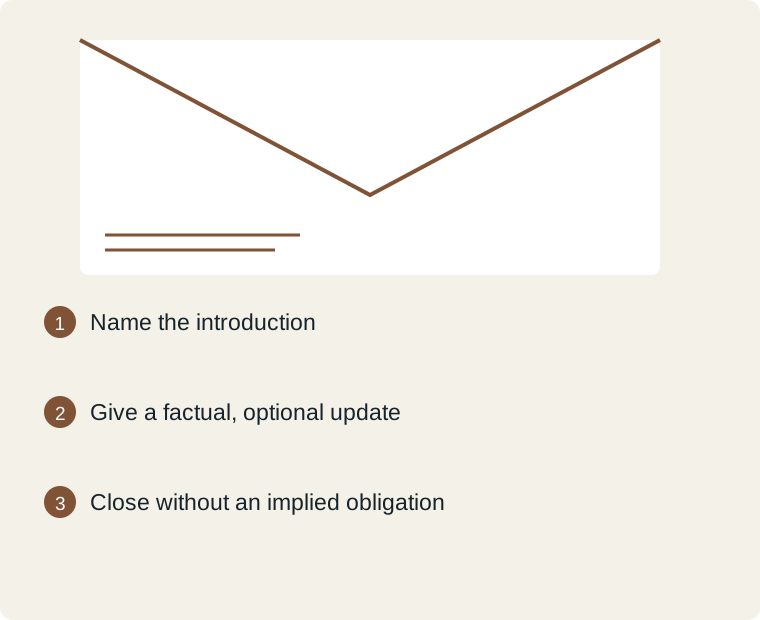
Text equivalent: Name the introduction → Give a factual, optional update → Close without an implied obligation
| Field | Completed example |
|---|---|
| Favour to thank | Introduction to Alex |
| Verified update | I have sent a reply |
| Uncertain outcome to omit | No job offer claimed |
| Private details to exclude | No application identifiers |
| Tone and channel | Short email |
| Closing sentence | There is nothing further you need to do |
Blank worksheet and worked example ↓
Primary context: Acas: recruitment process context
After training: thank someone and make the next step usable
A useful follow-up names what helped, identifies one action you control and avoids creating an obligation for the trainer. Use this fictional handover workshop example to write a specific message. Replace every bracketed field; do not copy a promise you cannot keep.
- Choose one concrete learning point rather than praising the whole session. Write what you will do differently and when. If you do not yet know, thank the trainer without claiming a result.
- Separate appreciation from a request. If you need a slide or clarification, ask one answerable question and allow the recipient to decline or redirect it.
- Keep internal incidents, customer names and colleagues’ performance out of the email. A thank-you note is not the place to attach a confidential case file.
- Send an outcome update only after you have tried the action. Describe what happened, including uncertainty. Do not credit a training session with a measurable benefit you did not measure.
![Subject: Thank you for the handover workshop; Message: Hi [Name], thank you for explaining how to give each handover item a named owner. I will add an owner and due date to our next draft on [date]. The incomplete example made that gap easy to spot. Best, [Name]; Optional separate request: Is there a shareable blank version of the checklist? If not, I can build one from my own notes.](/assets/field-20261014/training-follow-up-en.svg)
Diagram text: Subject: Thank you for the handover workshop; Message: Hi [Name], thank you for explaining how to give each handover item a named owner. I will add an owner and due date to our next draft on [date]. The incomplete example made that gap easy to spot. Best, [Name]; Optional separate request: Is there a shareable blank version of the checklist? If not, I can build one from my own notes.
| Field | Example or check |
|---|---|
| Subject | Thank you for the handover workshop |
| Message | Hi [Name], thank you for explaining how to give each handover item a named owner. I will add an owner and due date to our next draft on [date]. The incomplete example made that gap easy to spot. Best, [Name] |
| Optional separate request | Is there a shareable blank version of the checklist? If not, I can build one from my own notes. |
| Later update, only if true | I tried the owner field in one draft. Two items still needed a decision, so I have taken those back to our team. Thank you for the practical starting point. |
| Before sending | Check the date, name, permission to share materials and whether a reply is actually needed. |
For a group trainer, use “our next draft” only when you are authorised to speak for the team; otherwise say “my next draft”. If you missed the session, do not imply attendance. The worksheet offers an empty structure as well as this worked example, so your final message can remain your own.
Source context: ThanksFully: professional thank-you guidance